





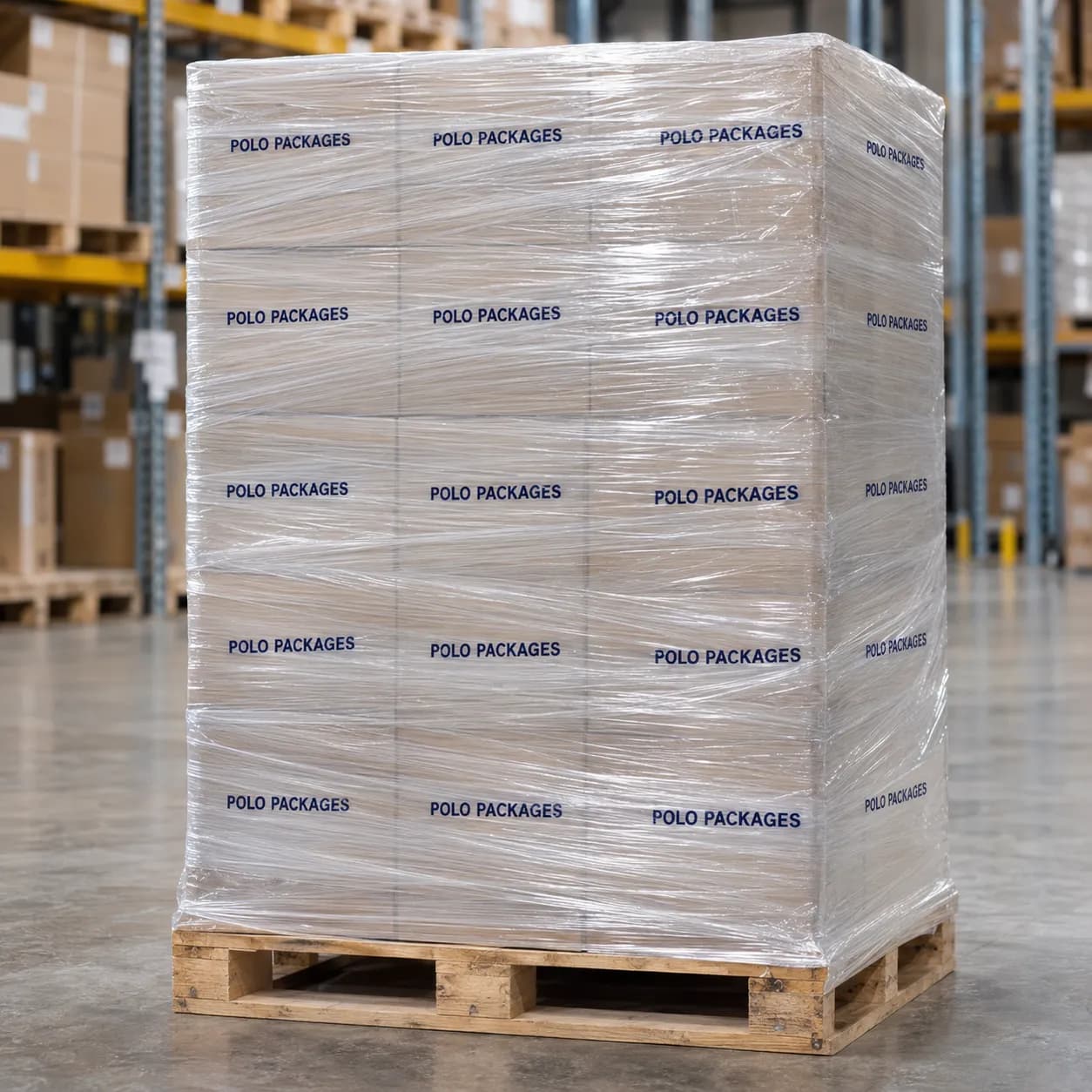
A pallet of cartons is only as safe as the film holding it together. Stretch film (also called pallet wrap or stretch wrap) turns a stack of loose boxes into one stable load that can be lifted, trucked and stored without shifting. Choosing the right film saves money, because the wrong one either tears on the first sharp corner or wastes film by needing too many turns.
This guide explains the main choices in plain language, so you can ask your supplier for exactly what your loads need.
What stretch film does
Stretch film is a thin plastic film, usually made from linear low-density polyethylene (LLDPE). It stretches as it goes on and then tries to return to its original length. That pull, together with the film's cling, holds the cartons tightly against each other and against the pallet.
- Load stability: cartons stay in place when the pallet is lifted, braked or turned.
- Protection: dust, rain and moisture stay off the goods during storage and transport.
- Security: a wrapped pallet shows at once if someone has opened it.
- Visibility: clear film lets warehouse staff read labels and scan barcodes without unwrapping.
Hand film or machine film?
The first decision is how the film will be applied.
Hand stretch film
Hand rolls are wrapped around the pallet by a person walking around it. They are made to tear easily by hand and usually have strong cling, so fewer turns are needed. Hand film suits businesses that wrap a modest number of pallets a day, mixed or irregular loads, and anyone without a wrapping machine.
Machine stretch film
Machine rolls are longer and heavier and are loaded onto a pallet wrapper, often a turntable that spins the pallet while the film carriage moves up and down. Most wrappers pre-stretch the film before it reaches the load. Guides from film makers commonly quote pre-stretch levels of about 150 to 300 percent, which means each metre of film on the roll covers far more of the pallet. The result is less film per pallet and the same tension every time.
A simple rule: if you wrap many pallets every day, a machine and machine film usually pay for themselves in film saved and time. For lower volumes, hand film is the practical choice.
Cast film or blown film?
Stretch film is made in two main ways, and each gives the film a different character.
- Cast film is very clear, unwinds quietly and is usually the more economical option. It is a good fit for regular, square loads such as cartons of the same size.
- Blown film is tougher and resists punctures and tears better, which matters for loads with sharp corners, edges or irregular shapes. It is less clear and typically costs more.
Thickness: thicker is not always better
Film thickness is measured in microns (one thousandth of a millimetre). Hand films commonly fall somewhere around 15 to 30 microns, and machine films are often thinner because the machine stretches them evenly. The right thickness depends on the weight of the load, how sharp its edges are and how far it will travel.
What matters most is the balance between thickness, how far the film is stretched and how well it resists puncture. A well-stretched thinner film can hold a load better than a thick film applied loosely. If you are unsure, test a few pallets with your real goods before buying in bulk.
How to wrap a pallet well
- Lock the load to the pallet. Start with two or three turns around the bottom, overlapping the pallet itself. A load that is wrapped tightly but not tied to the pallet can still slide off.
- Work upwards with overlap. Overlap each layer by about half the film width so there are no weak gaps.
- Keep the tension even. Too loose and the load moves; so tight that cartons crush or the film tears is too far.
- Finish at the top. Add a couple of turns around the top layer, and fold the tail under so it does not catch.
- Protect sharp corners. Use corner boards on loads with hard edges, or choose a blown film.
Common mistakes to avoid
- Wrapping only the cartons and not the pallet base.
- Using too many turns of film to make up for poor tension.
- Choosing film only on price per roll instead of cost per pallet wrapped.
- Storing rolls in direct sun or heat, which can affect cling and stretch.
Which stretch film should you choose?
Start with three questions: how many pallets do you wrap each day, how heavy and how sharp are the loads, and do you wrap by hand or with a machine? With those answers it is easy to narrow the choice down.
See our stretch film range, including hand stretch film and machine stretch film. Or tell us about your loads and our team in Lahore will suggest the right film and size.
